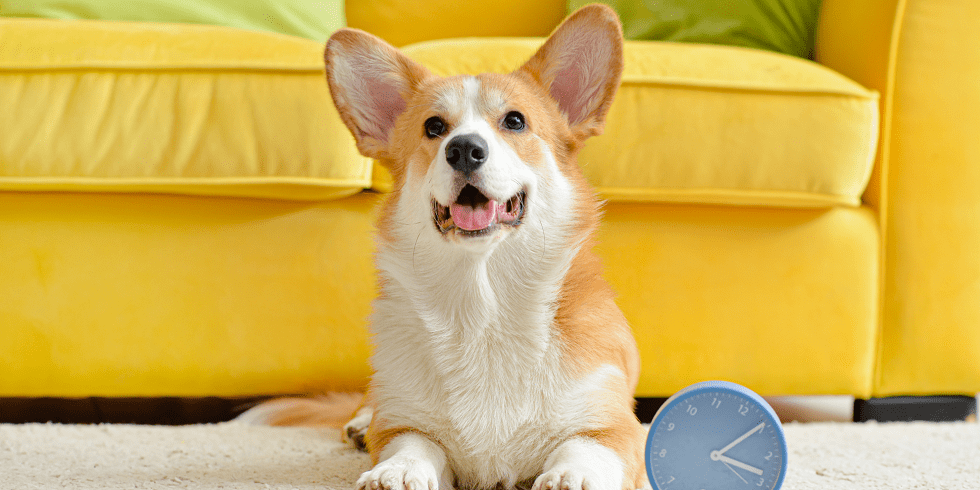


Do Dogs Have A Sense of Time?
This is an interesting question and one which many dog owners wonder about, especially when they have to leave their dogs at home, in kennels, or with a dog carer. Do dogs have a sense of time? If so, how does it affect their behaviour?

Mum should be home soon.
While dogs don’t understand the concept of what a minute, an hour, or a day means – they do have their own unique way of understanding the passage of time. Many dog owners have anecdotal evidence of how this might occur and how their dogs behave when it comes to the passing of time. But, what does science say about it?
Time and memory.
Having a concept of time is very much linked to the capacity for memory. Studies have shown that, dogs have a type of episodic memory, which means they can remember certain events in their lives. Episodic memory is useful for many animals. For example, it helps them locate food they may have stored over the winter.
Scientific studies.
A study carried out in 2011 and published in Applied Animal Behaviour Science found that when dogs were left alone for short and long periods, the dogs in the study, greeted their owners more enthusiastically after being left for longer, rather than shorter periods.
Researchers conducting the study concluded that, dogs were affected by the time left alone. Therefore, this suggests they have some concept of the passage of time.
A dog’s perception of time – yes, dogs can smell time!
Many owners believe their dog can tell the time. Dogs might wait for their dinner to arrive, or they may wait at the door for someone to return home as they do at the same time every day, for example.
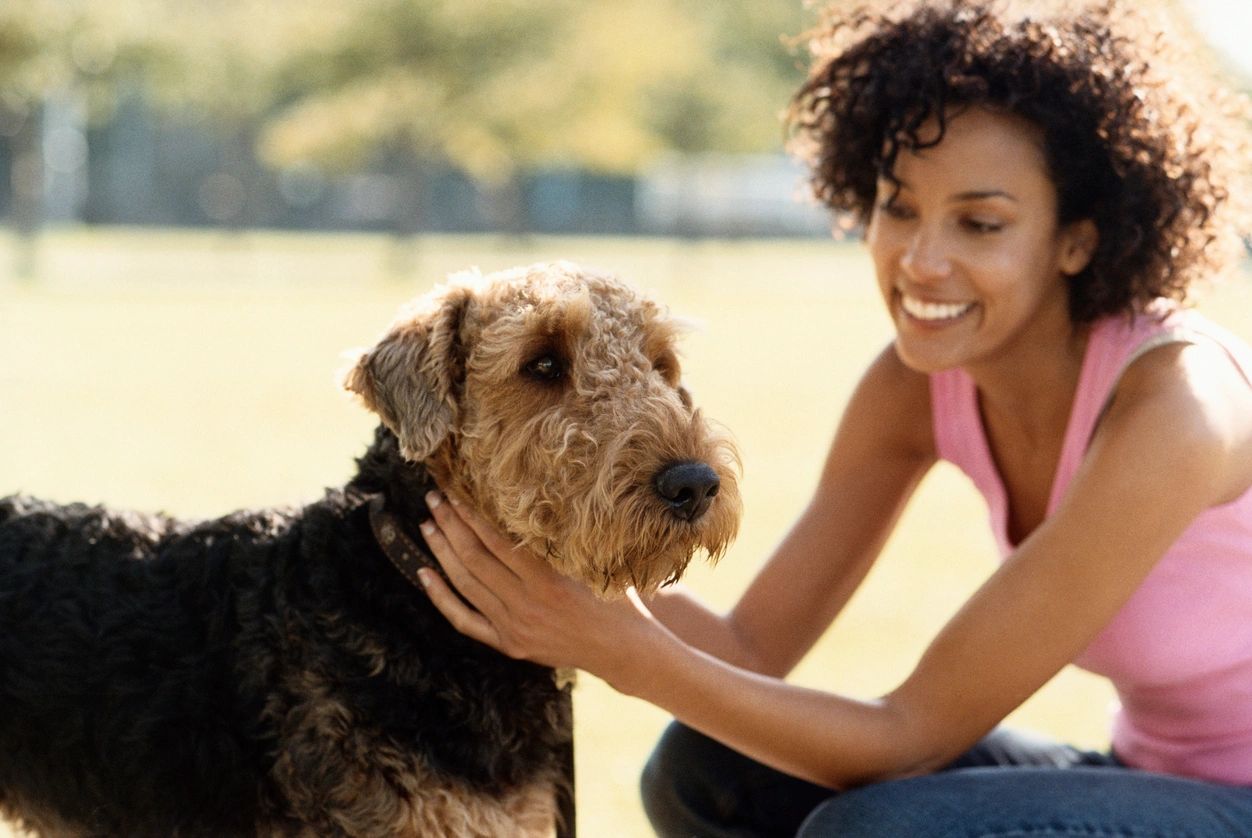
However, does this mean dogs really understand time? Dogs are very astute when it comes to picking up cues from their owners, or from the environment. Interestingly, the latter is where a sense of smell can be related to a sense of time. In a certain sense, dogs can use their sense of smell, to tell the time. This is a very interesting point.
A dog’s sense of smell is infinitely better than ours – 3oo million olfactory receptors, compared to just 5 million in humans. Dogs can take in smells continuously whereas, we have to breathe in, to really get our noses around a particular scent.
Dogs are so good at smelling, that they can detect cancer cells in people, or predict when someone is going to have a seizure.
Crucially, dogs can tell the difference between a recently laid scent and an older scent. Dogs can not only sense time past – where you went on your outing, but also what’s to come, by sniffing scents in the air.
Signals associated with time.
You may notice, as soon as you pick up your walking shoes or, a dog lead – your dog becomes excited. This may appear that your dog is a mind reader, but in reality, they are reacting to those visual cues. This will be even easier for the dog if you walk them, or give them their meal, at the same time every day.

A dog can sense signals in your body language – sometimes these are obvious, or more subtle. You may brush your teeth, or shut windows before you get ready to go for your walk, for example. These signals will not go unnoticed by your dog. Therefore, you may find that your dog appears to know it is the correct time for their walk.
Conclusion.
While dogs aren’t capable of reading a clock, or a calendar, they may have a stronger sense of time passing than we think. There is much we still just don’t know about a dog’s sense of time.
However, if left alone for very long periods, dogs do get bored and they become stressed. This, we do know and it can have a detrimental effect on their welfare.
For further information on separation anxiety and how to deal with it, please read our other Holidays4Dogs articles on the subject.