

How Well Can Dogs Smell? – Amazing Facts About Your Dog’s Nose.
This Holidays4Dogs article will discover some incredible facts about how well dogs can smell. You may wonder how interesting a dog’s nose could be – surely they are just pretty good at sniffing out treats? However, there are some surprising feats a dog can achieve with his nose and some are truly astounding. Read on to find out more.
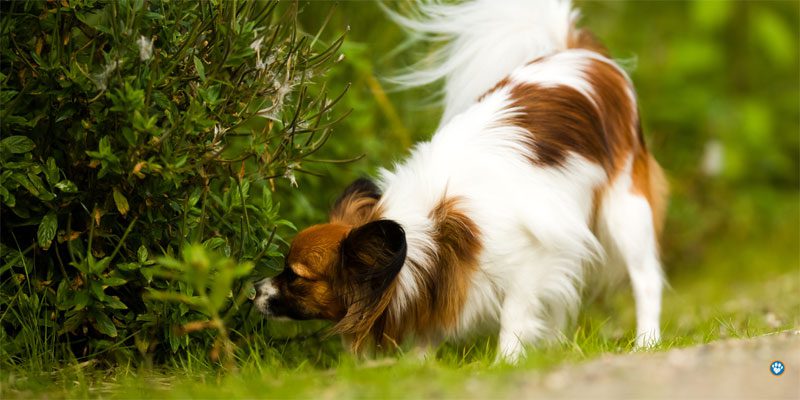
Compared to a human’s six million olfactory receptors, a dog has a whopping 300 million. In addition, the part of a dog’s brain that is responsible for processing these smells is about forty times greater than a person. It is little wonder then, that while humans generally interpret the world primarily through sight, a dog understands the world around them, by taking information from things they smell.
Pheromones.

Dogs don’t just smell basic scents like food cooking. They both produce and detect delicate pheromones by smell. This is one of the main ways dogs communicate with one another. The pheromones that each dog gives off, is capable of producing all sorts of behaviour responses by other canines.
What’s more, some of these pheromones can be detected by dogs over long distances. They are picked up by the vomeronasal organ, or Jacobson’s organ, located in the roof of the dog’s mouth.
This is often put to use when the male dog detects pheromones from a female dog in heat. You may have noticed, if you live with a male dog, he will chatter his teeth together as he processes the odour.
Because the dog’s sense of smell is so strong, they can be sensitive to certain odours such as smoke and perfumes and can find them overwhelming and uncomfortable.
Twitching noses.
When your dog sniffs the air, you will see them wiggling their nose. This is another thing that humans cannot do – wiggle their nostrils independently. Remarkably, When a dog breathes in, they are able to tell which nostril the scent arrived in. As they breath out, air is blown through the slits at the side of the nostril in order to analyse the odour.
What a dogs nose knows – what sort of scents can dogs smell?
It has long been known that dogs are capable of remarkable feats of scent tracking. This might entail looking for lost people, or criminals, often in unfamiliar environments. Dogs are highly skilled at following a trail of minute particles.
In addition, they use scent emitted from the earth and from vegetation which is crushed when a person walks over it. They can also air-scent – smelling odours that are adrift in the air. They also have an incredible ability to detect where the scent is most concentrated.
The dog’s sense of smell is so acute that studies have shown they can detect early stages of cancer, including prostate and skin cancer.
They do this with remarkable results and, earlier this year, the charity Medical Detection Dogs, began trials to establish whether dogs could detect breast cancer equally successfully.
Medical Detection Dogs already train assistance dogs to help people with life threatening health conditions, such as diabetes.
There are numerous other ways in which dogs can use their noses to assist humans, from drug and bomb detection dogs, to arson and human remains specialist detection dogs.
From working sheepdog to bio-medical detection dog – the canine range of skill sets is nothing short of impressive.
Nose prints.
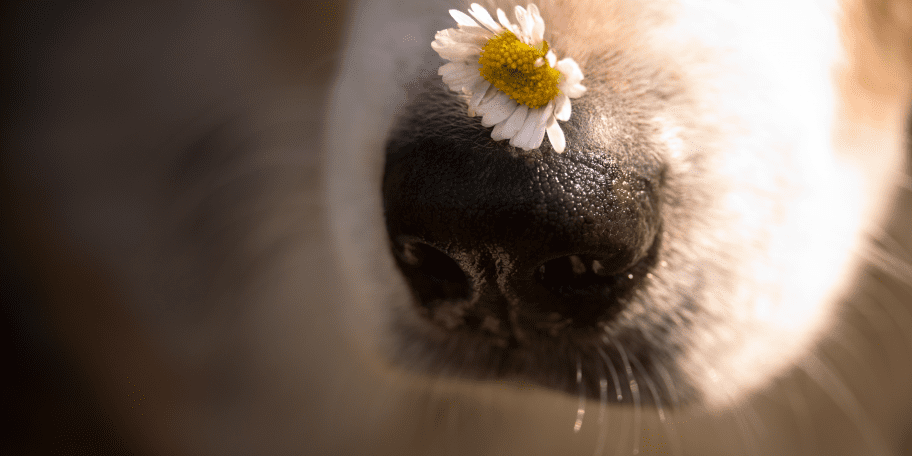
In the same way that people can be identified by their unique finger prints, so too can dogs – but by their nose prints. The surface of a dog’s nose is made of lines and creases, just like the indentations on a fingerprint. Incredibly, the Canadian Kennel Club has been accepting nose prints as proof of a dog’s identity since 1938.
There are even many small art and craft companies using dog nose prints to produce unique gifts in the form of cards, jewellery and key rings.
Dogs with the best sense of smell.
Top of the list is the Bloodhound who has more scent receptors than any other breed. They are experts at following both ground scent, (where those large dangly ears ‘funnel’ the scent upwards) and air scent. The loose skin around the head and neck, helps to trap scent particles and retain the odour.
The Basset hound, also has impressive scenting abilities. Being low to the ground, they are mean tracking machines. English Springer Spaniels are another breed with astounding scent abilities. Because of their drive and also their handy size, they are frequently the choice of breed as narcotic, or explosive detection dogs.
How well can dogs smell? – try some scent games to find out!
Dogs just love using their noses. It’s a great way for them to stimulate their brains as well as their bodies. Indeed, a few tracking games will really tire your dog out and help them feel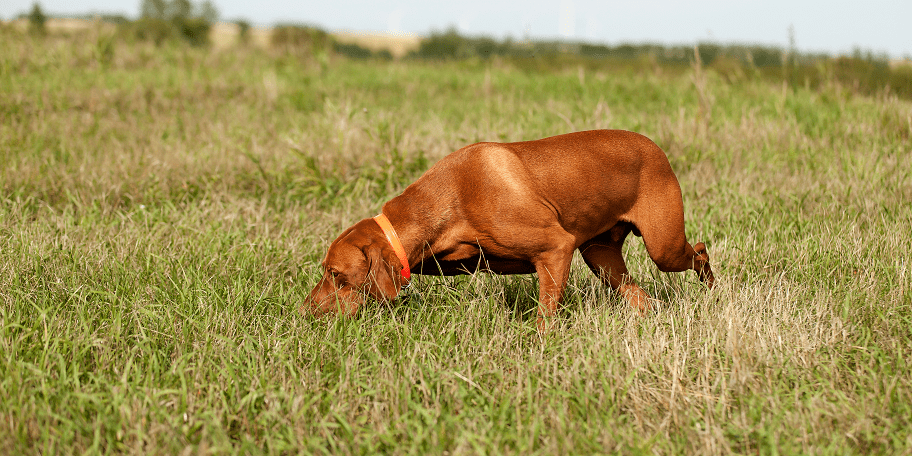 relaxed and calm. Scent games are great for hyperactive dogs and can give nervous dogs more confidence.
Start by hiding treats in containers, or lay a ‘track’ using food. Take tiny steps and place a tiny morsel of food in each footstep – as the dog stops to eat the food, they are also taking in the scent from the ground. Only lay short tracks in a straight line to begin with.
At the end of the track, either have a jackpot of food, or even better an old sock, or glove, with treats in it. As your dog progresses, get friends and family to lay tracks and make them longer, incorporating turns.
Use a harness for tracking and a long tracking line (suitable webbing, or lightweight rope will do). Remember this is just for fun – if you become hooked and want to take your training further, there are numerous clubs and associations across the UK to cater for tracking enthusiasts. The Kennel Club will have lists of obedience and working trials clubs.
If you want to know why your dog smells so bad – as in pongy! – read our other Holidays4Dogs article here.