


Do Dogs Watch Television?
Have you ever seen your dog watch the television? In this Holidays4Dogs article we take a look at whether dogs really can see television images and if so, what their favourite T.V. programmes might be.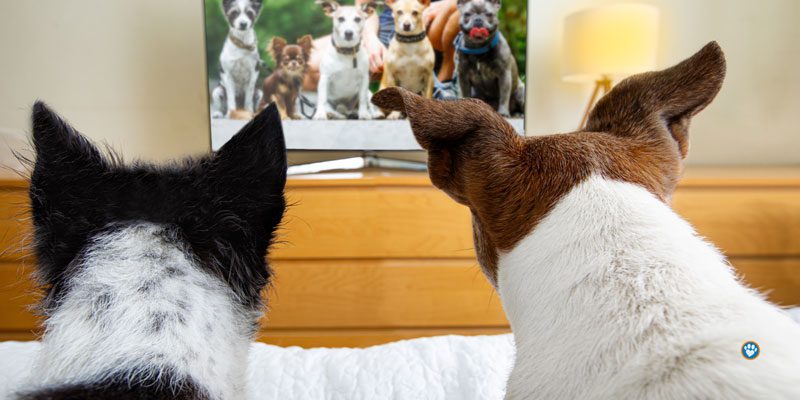
Anecdotally, many dogs do seem to spend time looking at what’s going on on the television. We’ve seen many of our own dogs and guest dogs seemingly interested in watching the telly. But, why would this be?
What does the science say?
Science tells us that dogs can, indeed, make sense of images on modern television screens. They are able to see images, just as they would do in reality. This ability can encourage some dogs to watch television.
A 2013 study published in the Journal of Animal Cognition showed that dogs could pick out other dog’s faces, among faces of humans and other animals, when displayed on a computer screen.  This proves that dogs can use their visual senses alone, to depict things they see on a television, or a computer screen.
What makes this possible is that, modern television screens have higher ‘refresh rates’.
The refresh rate refers to the speed at which one image is replaced by another. Humans can see images at up to 50 frames per second.
Dogs need about 70 mages per second in order to see a continuous image that looks like reality. Modern televisions typically have refresh rates of 240Hz, or even higher.
Therefore, it is easier for dogs to make sense of the images they see on a screen. As a result, many dogs do indeed watch television.
This is why dogs can perceive pictures on the television in much the same way we do. And, while dogs don’t see colour in quite the same way as people, they do react more readily to movement. This is another reason why television images can often attract their attention. If dogs see moving animals on the screen – on wildlife programmes, for example, – this can quickly gain their interest.
Television Personality.
Some dogs can be fascinated by sound and vision on the television screen. Others are more likely to ignore the box in the corner. Depending on the breed of dog, it can often make a difference whether a puppy becomes a telly addict, or not.
If your dog enjoys chasing squirrels, for example – wildlife programmes may be their thing. If, on the other hand, your dog enjoys ball games, they might become super interested in televised football, or tennis games.
Hounds tend to navigate the world using their heightened sense of smell, so might be less interested in moving images. Other breeds of dog, such as terriers and border collies, are often more interested in movement. This may mean, these dog breeds are more inclined to enjoy some televisual channel hopping.
Dogs have their very own TV channel?!
Yes, that’s right! The fact that dogs make up a potentially large TV audience, means they can now have their very own television channel. In 2012, DOGTV launched a ranged of scientifically designed programmes to help keep dogs happy throughout the day, especially when they have to be left home alone. The special programmes feature high rates of frames per second. Also, colours are set to match a dog’s unique visual spectrum of yellow-blue colours.
When to switch the box off?
While allowing your dog to watch television isn’t harmful in itself, it’s not a good idea for this to be a substitute for walking, or outdoor play. However, dogs won’t become addicted from watching too much television. Indeed, most dogs won’t sit and watch TV for long periods. They are more likely to become bored and wander off, or fall asleep – much like many of our two-legged companions 🙂
Television can be useful for dogs with separation anxiety as it does provide a certain amount of stimulation which helps some dogs to feel more calm and less stressed. And – after a long countryside walk – what could be better than cuddles on the sofa, while catching up with your favourite TV programmes together?
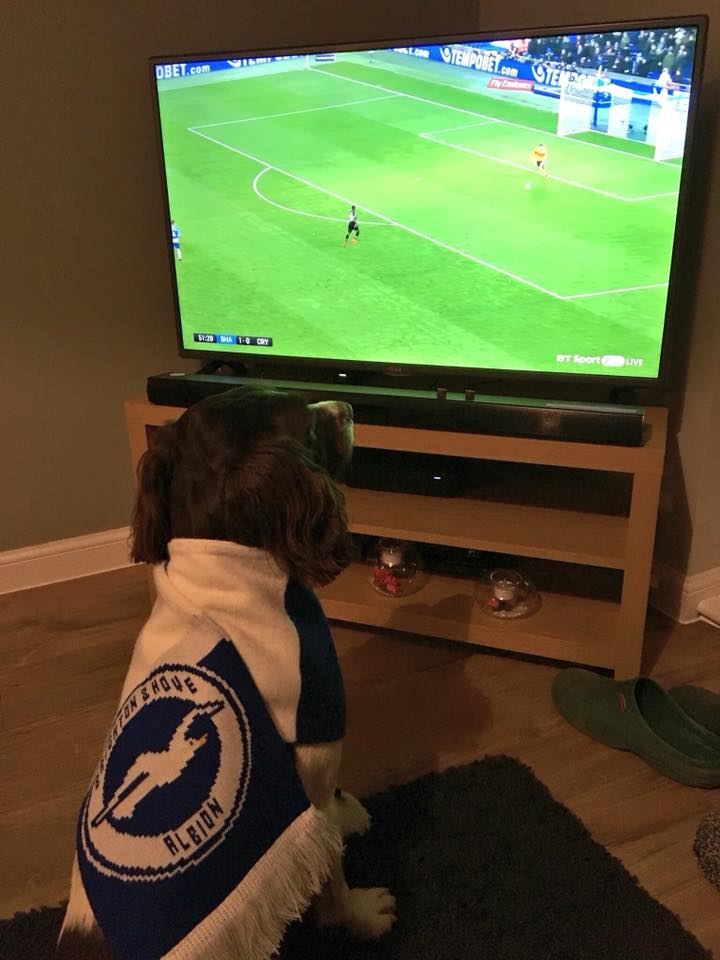
Dylan – one of our guest dogs watching the footy!