


The Human-Canine Bond.
In this article, Holidays4Dogs we dive into the subject of the human-canine bond. Why do people develop such strong attachments to their pet dogs? People can have strong connections with all sort of different animals – but dogs are seen as ‘man’s best friend’. Read on to find out why this bond can be so intense.

A cooperative working relationship.
Historically, dogs were working partners with human beings. This occurred in many parts of the world where people realised the benefits of having dogs around. This was probably a mutual benefit too as dogs were fed, sheltered and protected. Dogs helped people with hunting, herding and guarding as they still do today.
The working relationship might not be quite the same for many dogs these days. However, dogs assist people in more and more complex roles such as, seeing-eye dogs, support dogs, sniffer dogs and conservation dogs – to name but a few. Companionship is a number one role for many dogs and some have even been bred to fulfil this function.
Dogs promote social cohesion.
Dogs are wonderful companions and many people love them for this reason. It comes as no surprise perhaps that, pet owners have been shown in studies to be far less lonely than non-pet owners.
While this is true, it also known that dogs can help us to make social connections with other people. Many dog owners have made new friends, because of their mutual love for dogs.

Also, just like people, dogs are pack animals and, as such, seek social connection with others. This similarity helps to strengthen the bond between the two species. Dogs seem to need that social connection with people as much as they do with their own species. Sometimes, dogs even seem to prefer it. People too often gravitate towards the company of dogs in preference to people. Perhaps this is how strong connections are made.
The motivation for dogs to be sociable with human beings stems from their evolutionary history with us, which involved a process of domestication. In addition, a dog’s cognitive abilities means that they are able to navigate the human world fairly well – as long as we also take the trouble to listen to their language. Science is learning more all the time about how dogs understand and interpret the world around them and we now know, dogs are far more capable of this than was once thought.
Dogs are not wolves.
Research tells us that, dogs are not wolves and there is now plenty of evidence to show that dogs do not behave the same as wolf packs – either captive, or in wild groups. While it is commonly stated that dogs have derived from the wolf species, scientists believe they may share a common ancestor, rather than being domesticated directly from wolves.
Wolves in captivity, for example, will will become agitated if separated from their wolf pack and seldom bond with their human caretakers – particularly if this involves being in unfamiliar territory. This is not true of domesticated dogs, who very readily bond with their human caretakers.
Attachment levels towards humans.
Research on dogs has tested attachment levels between pairs of dogs that have lived together all their lives. During the experiment, each pair of dogs (8 dogs in total – aged 7-8 years), were separated for four hours.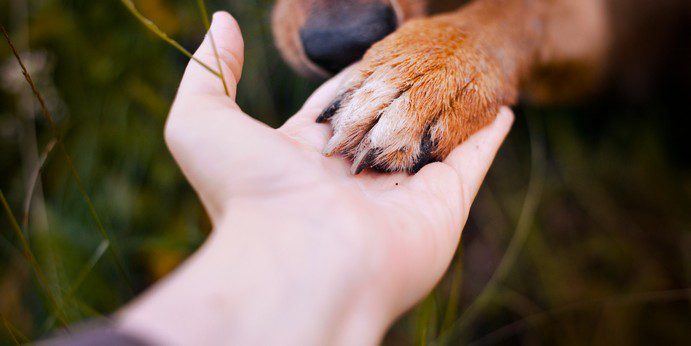
The researchers removed one dog from the kennel and observed the second. None of the dogs left alone without their kennel mate showed any signs of anxiety as long as they were in their familiar environment.
The researchers then moved the dogs to an unfamiliar kennel. While stress hormones were recorded as increasing by 50% the dogs did not interact much with each other, or make any attempt to take comfort from one another.
Finally, the experiment put each dog into a strange kennel with the company of its caretaker. In each case, the dogs would seek comfort from the human by getting close and instigating petting. Each dog’s anxiety reduced after interaction with the person.
The conclusion reached was that the dogs appeared to have a much stronger bond with their human caretaker than they did with their kennel mate, even though they had lived with them all their lives.
Selective breeding and socialisation.
Undoubtedly, pet dogs have been selectively bred to live and work with humans for centuries. People don’t just love dogs, they have a long history of working with them too. It is, therefore, not incomprehensible that some dogs prefer the company of people, over other dogs.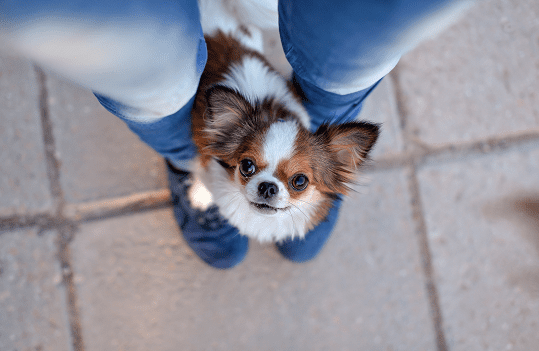
This may be even truer of specific dog breeds. Chihuahuas, for example, were specifically bred as companion dogs and living hot water bottles for ladies. They had no need to run, or live in packs, or indeed to mix with dogs much at all. They have been selective bred as holdable companions, with few opportunities for natural behaviour.
It is little wonder then, that toy dogs like these, have a reputation for being feisty and argumentative. Especially, with their own species – and frequently, with dogs three, or four, times their own size. Many people still love these little dogs and their big characters though.
Nature and nurture.
Environment, experience and genetics are all relevant to how dogs respond to people. Dogs bred specifically to work with humans are, perhaps, biased to bond with their human partners. Herding dogs like Border Collies, for example, typically lack sociability with unfamiliar dogs.
Socialisation of the dog through key development phases is also a contributing factor. A dog, lacking in social skills within their own species, may well prefer people over dogs for the rest of their lives. The way in which dogs bond with people in this way, perhaps, another factor why people love dogs so much.
Conclusion.
The canine-human bond is fascinating. Dogs are capable of providing purpose and meaning in people’s lives by lifting a person’s mood, providing companionship, or helping with physical tasks. They touch our hearts and highlight the human need for love and companionship.
They are an inspiration for our own unique abilities to love, nurture and care to come shining through. But it isn’t one sided. Dogs, too, gain a great deal of comfort and confidence from the people they live with in the human world.

While we may sometimes prefer the company of our pets, instead of people, we should remember – a dog brings out the very best of our own human qualities – an essential element for a harmonious society. There is undoubtedly something wonderful in that canine-human bond that has developed over many centuries of our lives together.